03. THE RECORD+
You are looking at the consequences of a practice sustained over 15 years.
A vision without structure is merely friction.
It is everything that allows meaningful work to continue over time.
Every body of work has developed a different structure.
Exploring color as an autonomous perceptual system.

QUESTION
Can a minimal chromatic system generate the perception of an unlimited spectrum?
CONTEXT
The investigation combines flat chromatic fields with three-dimensional interference to examine whether color relationships alone can sustain perceptual movement.
LIMIT
Restrict the system to four colors.
RESPONSE
The experiment confirmed that perceived chromatic richness depends more on the observer´s interaction than on the number of colors.
THE TRIGGER:
The series originated after repeated observations of the Venezuelan Ávila mountain, whose color transitions suggested a chromatic system rather than a landscape.
You are not aware of it, yet there it is.

Order does not eliminate uncertainty. It gives it direction.

Order does not eliminate uncertainty. It gives it direction.
Exploring how curvilinear forms can sustain optical movement without abandoning their geometric identity.

QUESTION
Can circular geometry generate the same optical dynamics traditionally reserved for parallel linear systems?
CONTEXT
Kinetic transitions operate optimally through straight parallel lines; introducing a circumference naturally resists the progressive shifting required to trigger the optical effect.
LIMIT
Fragment circular geometry into vertical linear frequencies while preserving its perceptual identity.
RESPONSE
Optical movement can emerge from circular systems when geometry is translated into controlled linear frequencies.
THE TRIGGER:
The investigation began after observing the coexistence of rigid architectural grids and curved spatial rhythms throughout Venice.

The perception of movement emerges without mechanics.
Order does not eliminate uncertainty. It gives it direction.

Exploring whether organic forms can coexist with optical order without diminishing either system.

QUESTION
Can organic movement be integrated into an optical system without disrupting its perceptual coherence?
CONTEXT
The investigation was tested within a contemporary architectural environment, where industrial materials and strict spatial order provided an ideal setting to evaluate whether an organic kinetic language could integrate without visual conflict.
LIMIT
To introduce organic geometries without altering the architectural logic of the surrounding space.
RESPONSE
The intervention demonstrated that organic optical systems can coexist with industrial architecture without compromising either visual language.

The perception of movement emerges without mechanics.
Order does not eliminate uncertainty. It gives it direction.

The perception of movement emerges without mechanics.
Order does not eliminate uncertainty. It gives it direction.

The perception of movement emerges without mechanics.
Order does not eliminate uncertainty. It gives it direction.

The perception of movement emerges without mechanics.
Order does not eliminate uncertainty. It gives it direction.

Order does not eliminate uncertainty. It gives it direction.
Exploring how ancestral proportional systems can generate contemporary perceptual structures.

QUESTION
Can knowledge embedded in ancestral symbolic systems remain structurally valid when detached from its original cultural context?
CONTEXT
Most proportional systems in Western art descend from classical geometric traditions. This investigation explores whether the Chacana—an ancestral Andean proportional structure—can serve as an equally rigorous framework for contemporary optical composition.
LIMIT
To preserve the proportional relationships of the Chacana while translating them into an autonomous chromatic system.
RESPONSE
The experiment demonstrated that ancestral proportional systems can remain structurally coherent even when translated into an entirely contemporary visual language.
THE TRIGGER:
The Chacana attracted my attention not as a cultural symbol, but as evidence that sophisticated proportional thinking existed far beyond the classical Western canon. That realization opened an entirely new field of investigation.

The perception of movement emerges without mechanics.
Order does not eliminate uncertainty. It gives it direction.

The perception of movement emerges without mechanics.
Order does not eliminate uncertainty. It gives it direction.
Structure without audacity never meets reality.
Audacity is the willingness to test structure against reality.
Each context demanded a different response.
Applying kinetic systems to hospitality environments.

ABSTRACT
Documentation of a 20 m² site-specific modular installation suspended above the main dining room of Pisco y Nazca Ceviche Gastropub (Bethesda, MD).
Conceived as part of The Chacana Series, the project transforms a permanent architectural condition into a passive optical system where geometry, light and movement continuously interact.
CONTEXT
In October 2023, during the Design Development phase led by the architectural team, DAC Art Consultant commissioned a spatial interpretation of the traditional Peruvian symbol, The Chacana.
The project required a remote execution framework capable of translating a conceptual investigation developed in Vigo (Spain) into a fully engineered installation fabricated in Europe and deployed in the United States.
CHALLENGE
The intervention operated under three simultaneous constraints:
• Structural Compliance: Full adherence to US regulations governing suspended public installations, including load calculations, seismic anchoring, and fire-retardant specifications.
• Architectural Integration: The system had to coexist with existing HVAC infrastructure, electrical layouts and lighting grids without altering the building's mechanical framework.
• Logistics: Every module had to be disassembled, internationally transported and manually reassembled on site while preserving millimetric precision.
RESPONSE
The solution materialized as The Chacana Series: a rigid modular structure composed of ten wooden units measuring 150 × 150 × 12 cm.
Rather than relying on mechanical movement, the installation uses geometry itself as an optical device. The depth of each module fragments the existing light, producing changing chromatic perceptions that depend entirely on the movement of the observer.
Movement emerges without mechanics.
RESULT
Installed and completed in May 2025, the intervention met all structural, regulatory and logistical requirements without modifying the existing architectural infrastructure.
The project functions as a permanent kinetic environment generated exclusively through geometry, light and human perception.
PORTABILITY
The installation was conceived as a modular system. Each unit can be detached, transported and reinstalled independently while preserving its condition as an autonomous artwork.
Every panel is individually signed and accompanied by its Certificate of Authenticity.
The architecture may evolve. The artwork remains.
RESEARCH CONTINUITY
The installation is not an isolated commission but part of an ongoing body of research.
Its value resides not only in its physical presence but in its position within a continuously evolving investigation where each new work reinforces the coherence and permanence of the whole.
Architecture becomes part of the artwork.
Scaling perceptual systems into immersive public installations.

ABSTRACT
A 120 m² kinetic installation developed for Urban Nature, a terrace concept designed to transform an outdoor space into an immersive sensory experience.
CONTEXT
CAM & Francia Architects envisioned a terrace that integrated movement as part of the spatial experience, rather than as a decorative element.
Using six-meter Amazonian wooden lattices to subtly define the perimeter, we created a dynamic environment that responded to the visitor's movement and perspective.
CHALLENGE
To evoke the openness and freedom of nature while establishing a clear spatial boundary.
RESPONSE
The installation transformed circulation into an exploratory experience, encouraging visitors to interact with the space as they moved through it.
RESULT
An immersive environment where movement, natural materials and warm lighting combined to enrich the perception of the space.
RESEARCH CONTINUITY
This project demonstrated how kinetic principles can be integrated into architectural environments, extending the research from autonomous artworks toward spatial experience.
The work is part of the architecture, immersive, ludic & warm.

ABSTRACT
Fernando Álvarez Arquitects commissioned a kinetic artwork as an integral part of the "Studio Lab" concept presented at CASACOR Peru 2023.
CONTEXT
CASACOR is Latin America's leading architecture, interior design and landscaping exhibition, held annually in cities including Lima, São Paulo, Bogotá, Medellín and Santa Cruz. It brings together architects, designers and artists to present innovative spatial concepts.
CHALLENGE
To integrate a three-dimensional kinetic artwork into a bold industrial interior, reinforcing the architectural narrative without competing for visual attention.
RESPONSE
The artwork established a dialogue with the space through movement, geometry and color, becoming a natural extension of the Studio Lab concept rather than an isolated artistic element.
RESULT
The installation attracted strong visitor interest throughout the exhibition. "Bridges of Creativity" was acquired by a private collector in Geneva, Switzerland, shortly after the event.
RESEARCH CONTINUITY
This project explored how kinetic structures can complement interior architecture by balancing organic movement with geometric order and chromatic compositions.
The proposal became part of the design, creating an immersive, playful and welcoming spatial experience.
Embedding geometric research into permanent educational spaces.
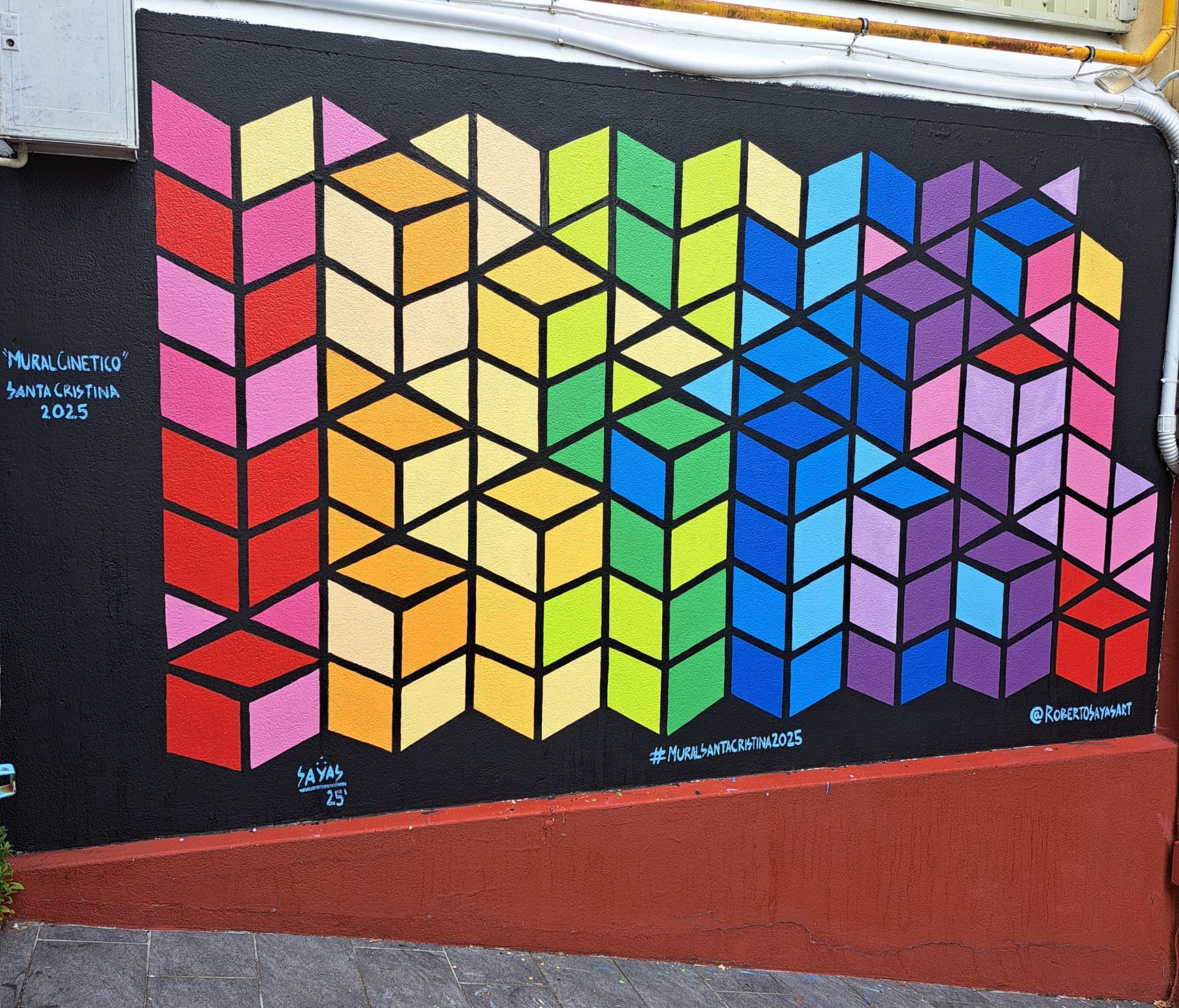
ABSTRACT
Collaborative mural intervention for a secondary school community.
CONTEXT
IES Santa Cristina invited the project as part of an extracurricular initiative to introduce students to collaborative artistic practice and public space.
CHALLENGE
To transform a shared educational environment into a place that encouraged creativity, participation and a stronger sense of community.
RESPONSE
Students took part in the creation of a large-scale geometric mural, experiencing how collective artistic action can reshape the perception of everyday spaces.
RESULT
A vibrant mural that became a lasting visual landmark within the school while strengthening engagement between students and their environment.
RESEARCH CONTINUITY
This project extended the research beyond galleries and private commissions, exploring how geometric language and color can foster participation, identity and a sense of belonging within educational spaces.
Art can serve as a tool for social and educational transformation.
Every meaningful work stretches existing capacity.
Building it expands that capacity.
Over time, the work transforms its author.
Every intervention changes more than form.
It changes the relationships a space can sustain.
Over time, architecture transforms the way people interact with it.
Every new challenge demands capabilities the organization has not yet fully developed.
Meeting those challenges expands its capacity.
Over time, the organization becomes capable of sustaining greater complexity.
The scale changes.
The context changes.
The mechanism remains.
Structured Audacity is a practice for developing the capacity to sustain increasing complexity.
Transformation is the inevitable consequence.
04. THE ENDORSEMENT+
Validated across different contexts.
Art & Institutions

• ART100 INDEX. Selected by the Visual Artists Association. London, UK. 2025.
• 2022 - Professional Artist of the Year Award. Finalist. Visual Artists Association. London, UK.
• Represented by "Fidelitas Arte". Art & Investment Group. Madrid, Spain. (2026).
Space & Architecture:
• Project: "Urban Nature"- kinetic ambiance installation. ExpoDeco 2023. Cam & Francia Architecture Studio. Lima, Perú. (2023).
• Project:Pisco y Nazca Gastropub. Kinetic art installation. Main dining room. Bethesda, Maryland, USA. (2025).
• Project:"Studio Lab". Casacor 2022. Installation. Fernando Alvarez Architecture Studio. Lima, Perú.
Systems & Organization:
• Project: B2B Growth Prospecting Model. Starnaliza Holding. 2026.
Observed Outcomes: Conversion cycles reduced from 9 months to 45 days | 70% reduction in operating costs | 3x effectiveness.
05.THE INVITATION+
Every conviction needs a new context.
Every meaningful work demands more than skill.
Not everyone is willing to build.
It demands becoming someone capable of creating it.
Perhaps yours is next...
